Insert-lock flat-bottom carton · Unfolding Diagram
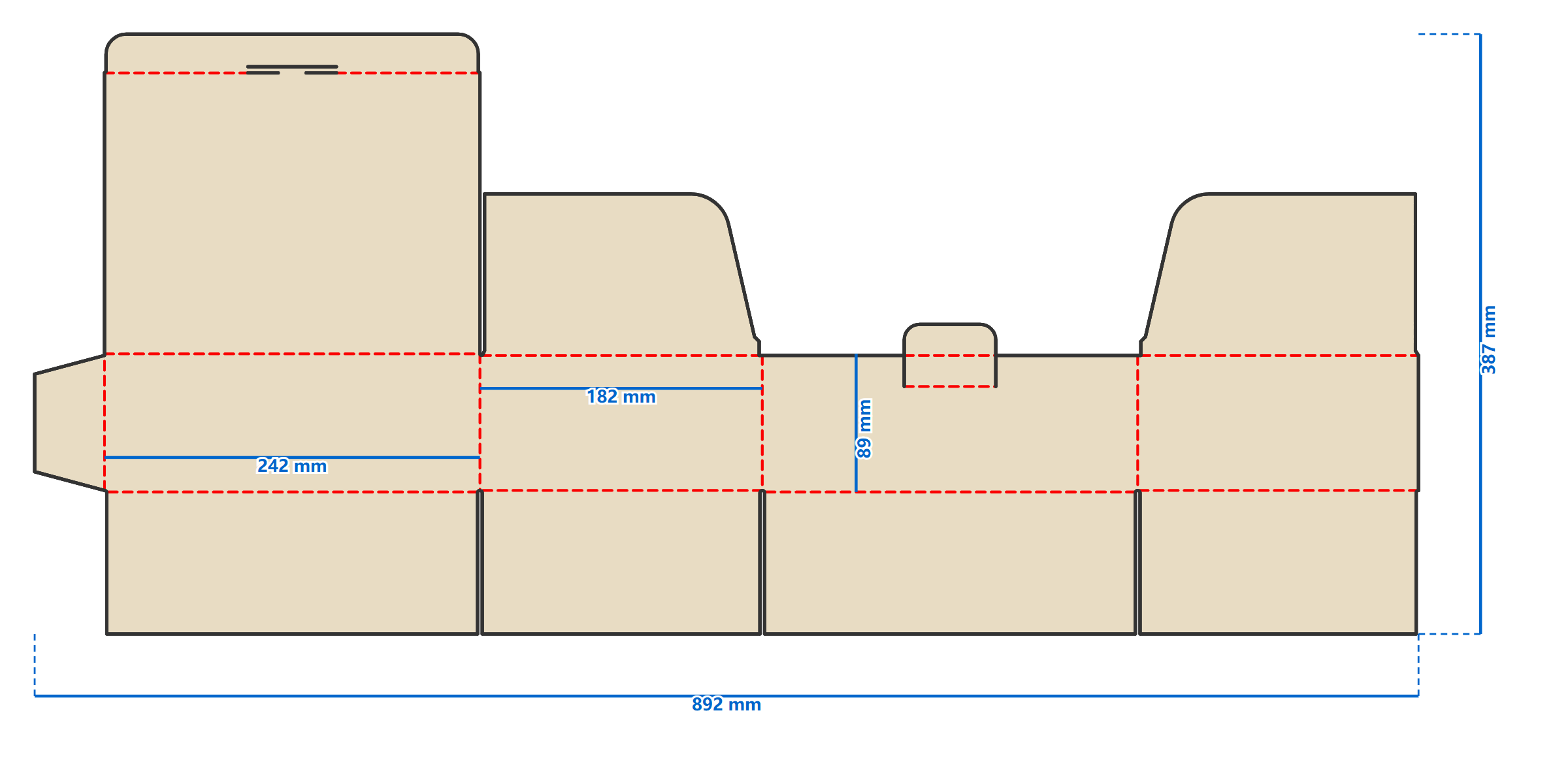
| Box style | Insert-lock flat-bottom carton |
|---|---|
| Typical use | Transit packaging / e-commerce fulfilment / warehousing / retail outer cartons |
| Inputs | L / W / H (mm), board thickness, glue flap and other advanced parameters |
| Exports | PDF, AI (Illustrator), DXF (CAD), SVG, PNG — 1:1 mm vector |
| Cost | Free to generate online; sign in for all box styles and exports |
Insert-lock flat-bottom carton is a standard corrugated carton structure. The tool ships a parametric dieline algorithm for it: pick the style, enter length, width, height and board thickness, and a 1:1 unfolding diagram appears with cut lines, crease lines, bleed and dimension annotations on separate layers — ready for the die-maker.
Structure & typical applications
One flat blank is glued into a tube (glue flap on the rear panel), the top closes with a rounded tuck tongue that locks under the two side top flaps, and the bottom is a flat crash-lock base: the front and rear bottom flaps fold in first and the two side base flaps lock over them, so no tape is needed. A semicircular tab on the top panel edge snaps into a matching slot on the tuck tongue to keep the lid from springing back; boxes longer than about 310 mm get a second tab-and-slot pair. Corner radii, slot widths and the glue flap allowance all scale with board thickness, which keeps the blank cuttable on standard corrugated tooling.
Measured material data for the Insert-lock flat-bottom carton dieline
Generated at this box's default parameters (L 242 × W 182 × H 89 mm, board thickness 2 mm, glue flap 45 mm), the blank measures 892 × 387 mm and uses about 0.345 m² of board per sheet. Total cut-line length is 3601 mm and total crease-line length is 2093 mm.
At 1.72×, cut and crease lines are nearly balanced — typical of a regular slotted carton, where both operations cost about the same. Die-makers commonly quote from the combined cut-line and crease-line length: laser cutting is billed by travel distance and creasing rule by length of steel.
| Blank size | 892 × 387 mm (bounding box of the unfolding diagram, bleed excluded) |
|---|---|
| Total cut-line length | 3601 mm — outer contour + internal slots, tabs and cut-outs |
| Total crease-line length | 2093 mm — crease and fold lines combined |
| Board per sheet | 0.345 m² / about 345.0 m² per 1,000 blanks (nesting waste excluded) |
Change any dimension and every figure above recalculates from the geometry — the canvas and the exported file update together.
Generate this dieline online
- Open the online carton dieline generator;
- Search for “Insert-lock flat-bottom carton” in the box list and select it;
- Enter L / W / H (mm) and board thickness — the canvas refreshes immediately;
- Switch to the 3D fold preview to verify the structure, then export PDF / AI / DXF / SVG / PNG.
Generate the Insert-lock flat-bottom carton dieline free →
Why generate dielines online
- No manual blank-size arithmetic: glue flaps, flap depths and tabs are derived from the box geometry;
- Compare styles side by side: 44 standard box styles (and growing) — switch between similar structures to compare board usage;
- Material-saving nesting: the tool computes a board-saving layout automatically;
- Ready for the die-maker: DXF/AI vector output goes straight to laser die-making and sampling equipment.
Related box dielines
Part of this series
Other styles in the same structural family are worth comparing:
Frequently asked questions
- What is the blank size of a Insert-lock flat-bottom carton unfolding diagram?
- At the default length 242 mm, width 182 mm, height 89 mm and board thickness 2 mm, the blank measures 892 × 387 mm and uses about 0.345 m² of board per sheet. All figures recalculate when you change the dimensions.
- How long are the cut lines and crease lines of a Insert-lock flat-bottom carton?
- At the default size the total cut-line length is 3601 mm and the total crease-line length is 2093 mm — a ratio of 1.72. Die-makers usually quote from these two figures (laser cutting distance + creasing rule length), so they directly affect tooling cost.
- What are the default parameters for a Insert-lock flat-bottom carton?
- The tool presets L 242 mm, W 182 mm, H 89 mm, board thickness 2 mm, glue flap 45 mm. Every value is editable; the dieline and dimension annotations refresh together.
- What defines the Insert-lock flat-bottom carton structure?
- One flat blank is glued into a tube (glue flap on the rear panel), the top closes with a rounded tuck tongue that locks under the two side top flaps, and the bottom is a flat crash-lock base: the front and rear bottom flaps fold in first and the two side base flaps lock over them, so no tape is needed. A semicircular tab on the top panel edge snaps into a matching slot on the tuck tongue to keep the lid from springing back; boxes longer than about 310 mm get a second tab-and-slot pair. Corner radii, slot widths and the glue flap allowance all scale with board thickness, which keeps the blank cuttable on standard corrugated tooling.